Digital printing and gravure printing are both used to produce custom printed coffee bags. The right choice depends on how many bags you need per design, how often your artwork changes and what you expect from the finished print.
Digital printing often suits shorter runs and multiple designs. Gravure printing can be economical for larger, repeat orders with stable artwork.
However, there is no universal order quantity at which one method becomes the better option. Compare quotations using the same bag specifications and consider the packaging you are likely to use—not only the unit price.
1. How Does Digital Printing Work?
Digital printing transfers artwork from a digital file to the packaging substrate without using engraved gravure cylinders.
This makes it practical to change designs between jobs and can reduce the setup commitment associated with individual artwork versions.
For coffee brands, digital printing may be worth considering for:
New product launches with uncertain demand.
Seasonal coffees and limited releases.
Several origins or roast profiles with different artwork.
Packaging designs that are still being tested.
Orders requiring frequent design updates.
Digital printing still involves file preparation, color management and production setup. It should not be assumed that every supplier offers zero setup charges, no minimum order or immediate production.
If the bag requires lamination, curing, cutting, pouch making or valve installation, those operations remain part of the production schedule.
2. How Does Gravure Printing Work?
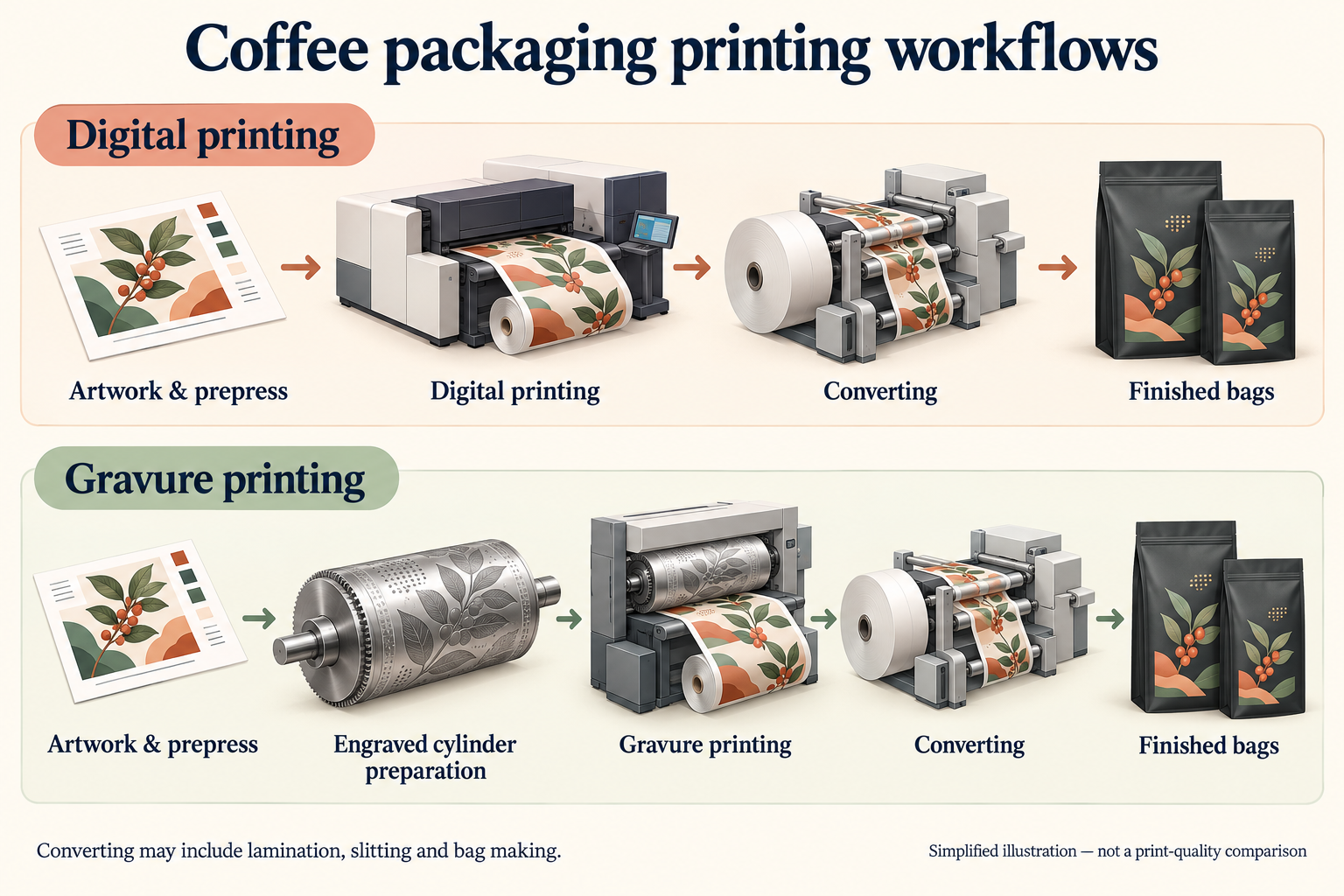
Gravure printing uses engraved cylinders to transfer ink onto the packaging substrate. A separate cylinder is typically required for each printing color or separation.
Preparing these cylinders adds an initial cost and setup stage. Once the tooling is available, gravure can support efficient production of longer runs.
This can make gravure worth evaluating when you have:
Established coffee products with predictable demand.
Larger quantities for each design.
Artwork that will remain unchanged across repeat orders.
Specific color or print requirements suited to the supplier’s press.
A purchasing plan that can absorb the production quantity.
Cylinder preparation does not automatically make gravure the more expensive choice overall. The initial cost needs to be considered alongside production volume, repeat orders and the agreed tooling terms.
3. Compare the Two Printing Methods
| Factor | Digital printing | Gravure printing |
|---|---|---|
| Printing setup | Does not use engraved gravure cylinders | Requires engraved printing cylinders |
| Order profile | Often useful for shorter runs and multiple designs | Often useful for larger runs with stable artwork |
| Artwork changes | Generally easier to introduce between jobs | Changes may require new or modified cylinders |
| Cost structure | Lower tooling commitment can help small projects | Initial tooling costs can be spread across larger volumes |
| Color performance | Depends on the press, ink system, substrate and color management | Depends on the press, inks, cylinders, substrate and process control |
| Repeat orders | Flexible when designs or quantities change | Can benefit from existing tooling when specifications remain unchanged |
| Production timing | May avoid the cylinder preparation stage | Initial orders require time for cylinder preparation |
| Finished bag quality | Depends on printing and the complete converting process | Depends on printing and the complete converting process |
Both methods can produce professional coffee packaging. The choice should be based on your project rather than a general assumption that one method always looks better.
4. Compare Quantities per Design, Not Just Total Volume
A total order quantity does not tell the full story.
For example, 10,000 bags with one design represent a different production requirement from 10,000 bags divided equally among ten designs. This is an illustration of order structure, not an MOQ recommendation.
For each design, tell your supplier:
Bag size and material structure.
Quantity required.
Artwork and color differences.
Required finishes.
Whether repeat orders are expected.
Ask whether designs can be grouped under shared production conditions and how minimum quantities apply. Do not assume different designs can always be combined simply because the bags have the same dimensions.
For gravure printing, shared artwork elements may allow some tooling to be reused, but the supplier needs to assess the actual color separations and layout.
5. Evaluate Total Cost and Inventory Risk
A lower price per bag can be attractive, but ordering more packaging than you can use ties up cash and storage space.
This matters for coffee brands that frequently change origins, seasonal products, label information or branding.
Compare the cost of the full purchasing plan:
Printing setup or cylinder charges.
Bag production.
Proofs and samples.
Special finishes.
Freight and storage.
Potential obsolete packaging after artwork changes.
Request quotations for realistic quantities rather than choosing a large volume only to reduce the unit price.
For gravure orders, clarify cylinder ownership, storage arrangements, reuse charges and what happens when artwork changes. These details can affect the cost of future orders.
6. Check Color and Finish Requirements
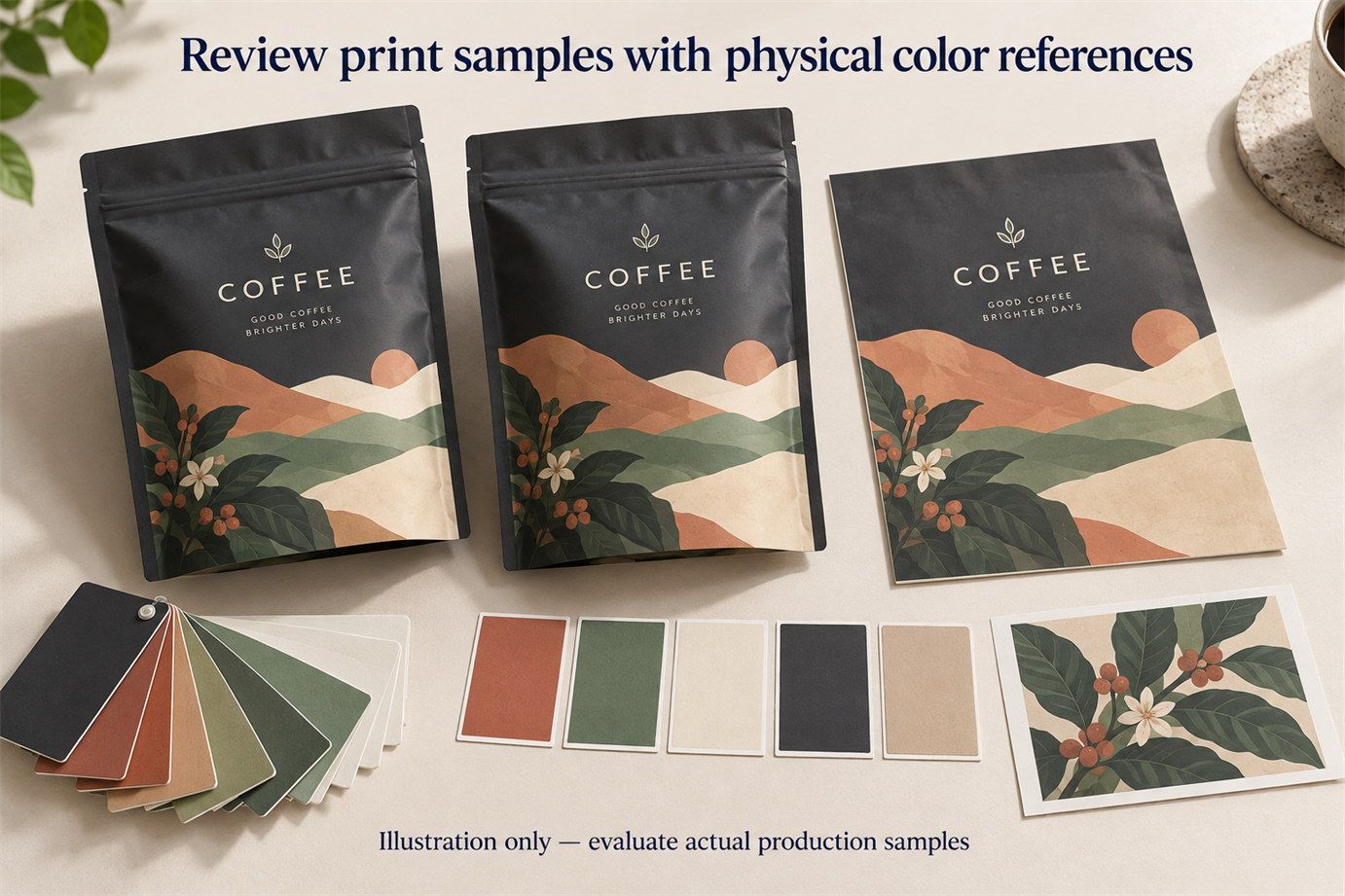
Neither printing method guarantees an exact match to the colors shown on your screen.
The substrate, white ink, ink system, surface finish and lamination can all affect the appearance of the finished bag. A design printed on a white surface may look different when printed over a metallic or transparent structure.
Before approving production, discuss:
Brand color references.
Whether spot colors or process-color simulations will be used.
White ink coverage, where relevant.
Matte, gloss or other requested finishes.
Small text, fine lines and barcode readability.
Expectations for consistency between production runs.
Ask what kind of proof is available and what it represents. A digital artwork proof can confirm layout and text, but it may not establish the final color or surface appearance.
Where color is critical, agree on an appropriate physical reference and acceptance criteria with the supplier.
7. Keep Printing and Barrier Performance Separate
Printing method alone does not determine how well a coffee bag protects its contents.
Oxygen and moisture protection depend on the complete material structure and package integrity. Valve installation, heat seals and the filling process also matter.
When comparing digital and gravure quotations, make sure the underlying specifications are equivalent. Otherwise, differences in price or performance may come from the materials rather than the printing method.
Both options should also be assessed for the intended food-contact application. Ask for relevant documentation covering the proposed packaging construction, inks and converting process.
Do not assume a bag is recyclable or more sustainable simply because it uses one printing method. Those claims require assessment of the complete package and the relevant end-of-life system.
8. Which Method Fits Your Coffee Brand?
Consider digital printing when you are testing demand, managing several smaller product lines or expecting frequent artwork changes.
Consider gravure printing when demand is established, quantities per design are larger and the artwork is likely to remain stable.
Some brands use different approaches for different products. A core coffee range and a limited seasonal release do not necessarily need the same printing strategy.
If both options are available for your specification, request comparable quotations and review samples. The practical choice balances cost, print requirements and the flexibility your business needs.
Frequently Asked Questions
Is digital printing always cheaper for coffee bags?
No. It can reduce the tooling commitment for shorter runs, but the final cost depends on quantity, materials, artwork, finishes and production requirements. Compare complete quotations.
Does gravure printing always produce better quality?
No. Both methods can produce high-quality results. Review samples relevant to your material, artwork and finish requirements rather than judging by the method alone.
What is the MOQ for digitally printed coffee bags?
There is no universal MOQ. It depends on the supplier’s equipment, material availability, bag construction and production rules. Ask for the minimum quantity for your exact specification and each design.
Can I change my design on a repeat gravure order?
Yes, but the change may require new or modified cylinders and a new approval process. Confirm the cost and timing before changing the artwork.
Is digital printing always faster?
Not necessarily. Avoiding cylinder preparation may shorten the initial setup stage, but material availability, production scheduling and pouch-making operations also affect delivery time.
Request a Printing Comparison for Your Coffee Bags
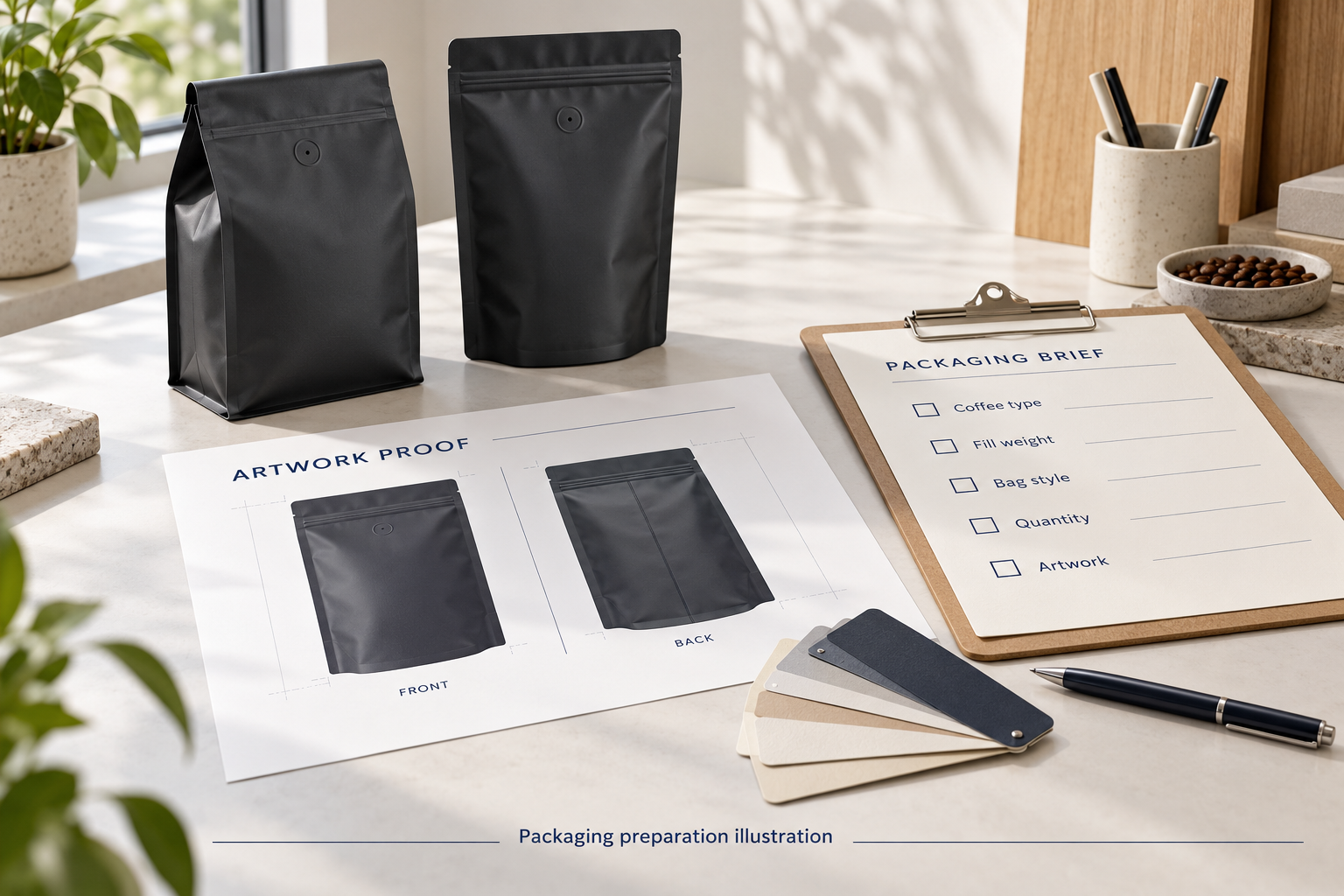
To discuss printing options with FWPacks, share your preferred bag style, material requirements, quantity per design and artwork files or design references.
Include any critical brand colors, surface finishes, expected repeat orders and required delivery date.
A clear brief makes it easier to compare printing options against your actual needs and identify suitable samples before production approval.