Choosing coffee bag materials starts with the protection your coffee needs and the way you pack, distribute and sell it.
Aluminum foil laminates, metallized films and PE-based structures can all be considered for coffee packaging. However, their suitability depends on the complete specification—not simply whether the bag looks metallic, feels thick or carries a “high barrier” description.
For coffee brands, the practical approach is to define the application, compare relevant material data and evaluate finished bags before approving production.
This guide explains the main material options and the questions to ask your packaging supplier.
1. What Does a Coffee Bag Material Structure Include?
A coffee bag may combine several layers, each serving a different purpose.
One layer may support printing and handling strength. Another may provide a barrier against oxygen or moisture. An inner layer provides the surface used for heat sealing and contact with the product.
Common abbreviations include:
| Material | Meaning | Typical role in a packaging structure |
|---|---|---|
| PET | Polyester film | Supports printing, dimensional stability and mechanical performance |
| AL | Aluminum foil | Provides a strong barrier against gases, moisture and light when intact |
| VMPET | Vacuum-metallized polyester film | Adds a thin metallic coating to PET to improve barrier and light protection |
| PE | Polyethylene | Commonly used for heat sealing and as a food-contact layer in suitable constructions |
| Paper | A paper layer, sometimes with a kraft appearance | Provides appearance, texture and some structural characteristics |
These descriptions explain typical functions, rather than guaranteeing the performance of a finished bag.
For example, PET/AL/PE and PET/VMPET/PE describe different laminate arrangements. They do not specify every detail needed for purchasing, such as layer thicknesses, adhesive systems, barrier values or sealing conditions.
Ask your supplier to identify the complete proposed construction and explain how it suits your coffee and packing process.
2. Aluminum Foil vs Metallized Film: What Is the Difference?
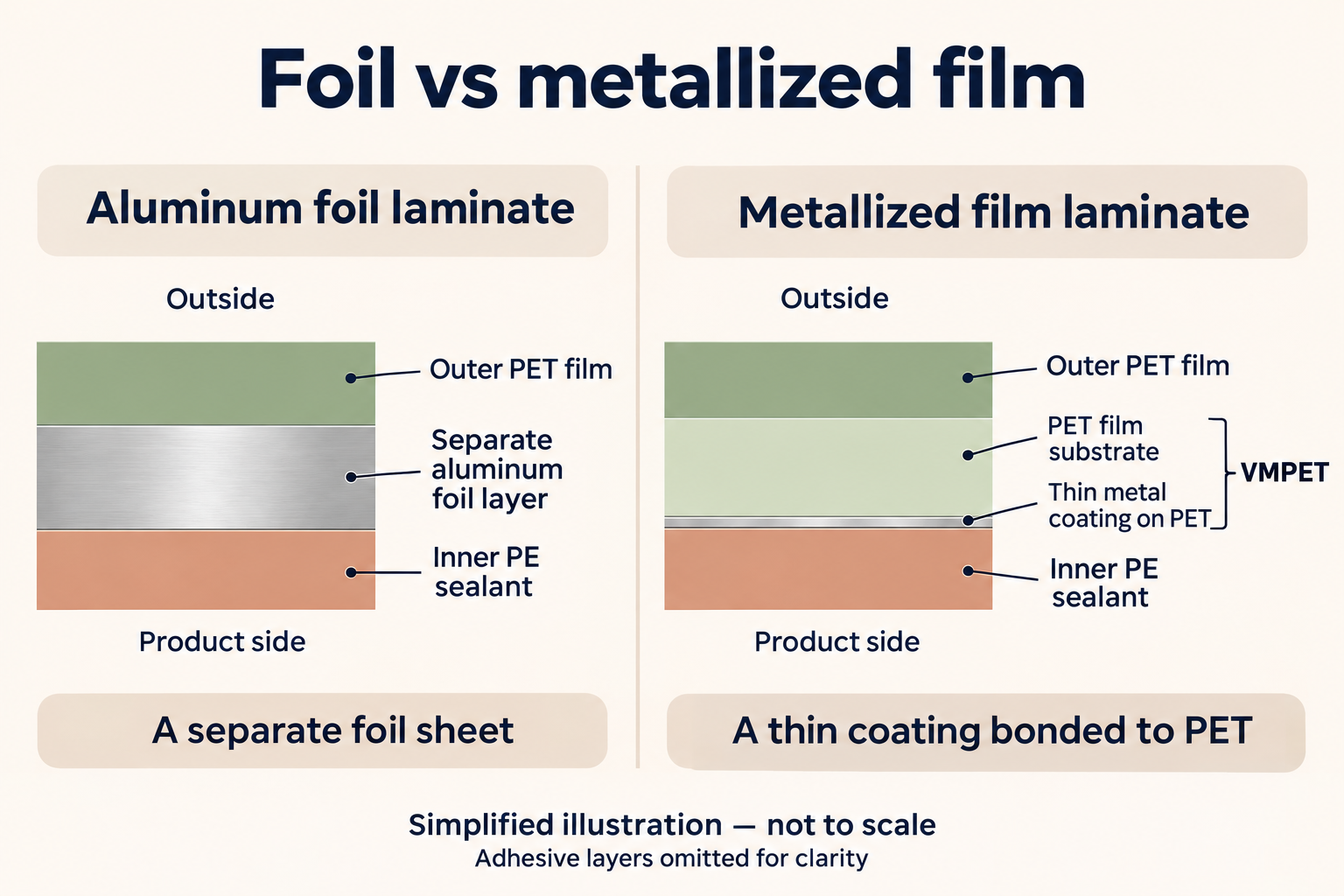
Aluminum foil and metallized film are different materials, even though both can create a silver appearance.
An aluminum foil laminate contains a separate foil layer. Metallized film has a thin metallic coating deposited onto a plastic film.
| Factor | Aluminum foil laminate | Metallized film laminate |
|---|---|---|
| Barrier component | A separate aluminum foil layer | A thin metallic coating on a film |
| Oxygen and moisture protection | Can provide very strong protection when the structure remains intact | Depends on the film, coating quality and complete laminate |
| Light protection | An intact foil layer blocks light | Depends on the coating and construction |
| Handling considerations | Evaluate flexing, creasing and possible damage to the barrier layer | Evaluate coating durability and barrier retention after converting and handling |
| Appearance | Often metallic unless covered by other layers or printing | Can also create a metallic appearance |
| Purchasing decision | Confirm finished-package requirements and performance | Confirm finished-package requirements and performance |
Neither option should be selected from appearance alone.
A metallic-looking interior does not prove that a bag contains aluminum foil. Likewise, a foil layer does not compensate for leaking seals or a damaged package.
Ask for the actual material specification rather than relying on terms such as “silver lining” or “foil-style bag.”
3. What Should You Know About PE-Based Coffee Bags?
PE-based structures are another option to discuss when developing coffee packaging, particularly where compatibility with a specific recycling stream is a design objective.
However, “PE-based” does not automatically mean that the bag has the barrier performance your coffee needs.
A structure may use different polyethylene grades and additional coatings or barrier components. These details affect protection, stiffness, sealing and the suitability of any recycling claim.
Before considering a PE-based option, ask:
What is the complete construction?
What oxygen and moisture barrier data are available?
Under which conditions were those values measured?
Does the proposed structure work with your filling and sealing equipment?
How are the zipper, valve, labels and other components assessed?
What evidence supports any recyclability claim in the destination market?
A material change can affect more than freshness protection. The bag may feel different, stand differently or require a different sealing setup.
Evaluate samples of the proposed structure instead of assuming it will behave like an existing foil or metallized laminate.
4. How Do You Compare Oxygen and Moisture Barrier Data?
Two measurements commonly used in flexible packaging are oxygen transmission rate and water vapor transmission rate.
Oxygen transmission rate, or OTR, describes oxygen passing through a material under specified test conditions.
Water vapor transmission rate, or WVTR, describes water vapor passing through a material under specified test conditions.
For otherwise comparable results, lower values indicate less transmission under those conditions.
However, numbers should only be compared after checking what they represent.
| Information to request | Why it matters |
|---|---|
| Test method | Different methods or reporting approaches may affect comparability |
| Temperature and humidity | Barrier performance can change with environmental conditions |
| Units and pressure basis, where applicable | Similar-looking numbers may describe different measurements |
| Tested construction and thickness | Data for another film may not represent the proposed laminate |
| Sample type | Flat-film data and finished-package results answer different questions |
| Reporting or detection limit | A result below a measurement limit is not proof of zero transmission |
Avoid choosing a bag from an isolated claim such as “excellent oxygen barrier.”
Request data relevant to the proposed construction and ask how the finished bag will be evaluated. Film data alone do not account for every possible route of oxygen or moisture entry through seals, valves or package damage.
There is also no single OTR or WVTR target suitable for every coffee product. The required performance should be assessed against your coffee, packing conditions, distribution environment and shelf-life objective.
5. Do Kraft Paper, Windows or Thicker Films Improve Protection?
Appearance and thickness can influence a packaging decision, but neither establishes barrier performance by itself.
Kraft Paper Appearance
A kraft paper outer layer can create a textured, natural-looking package. The underlying construction still needs to provide the required protection and sealing performance.
A paper appearance does not establish that the finished bag is recyclable, compostable or suitable for a particular shelf life.
Clear Windows
A window allows customers to see the product, but it changes the construction in that area.
A continuous opaque foil layer cannot cover the same area as a clear viewing window. The window therefore needs its own assessment for oxygen, moisture and light protection.
Ask how the window is formed and what performance data apply to that part of the package.
Film Thickness
Thickness can affect stiffness, handling strength and sealing behavior. It should not be used as a substitute for barrier data.
A thicker structure does not automatically offer a better oxygen barrier than a thinner structure made with different materials.
Compare the complete specification and its intended function.
6. Check Materials Together with Valves and Seals
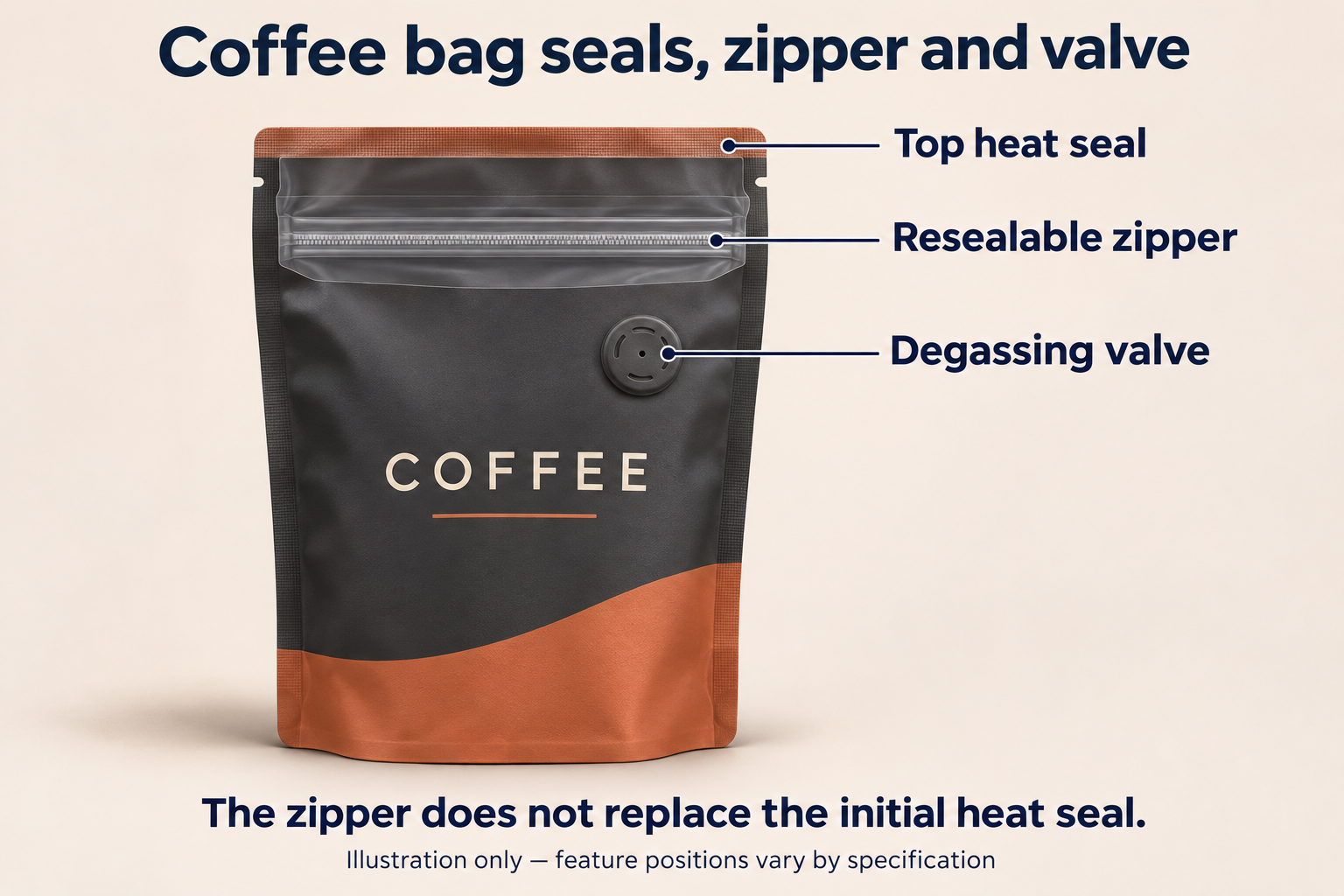
Coffee protection depends on the finished packaging system.
A suitable material can still perform poorly if the seal area is contaminated, the sealing process is unsuitable or a valve is incorrectly installed.
When evaluating samples, review:
Compatibility with your sealing equipment.
The recommended sealing temperature, dwell time and pressure.
Whether coffee particles enter the seal area during filling.
Seal integrity after normal handling.
Valve suitability and attachment.
Zipper operation and opening access.
Resistance to expected transport and storage conditions.
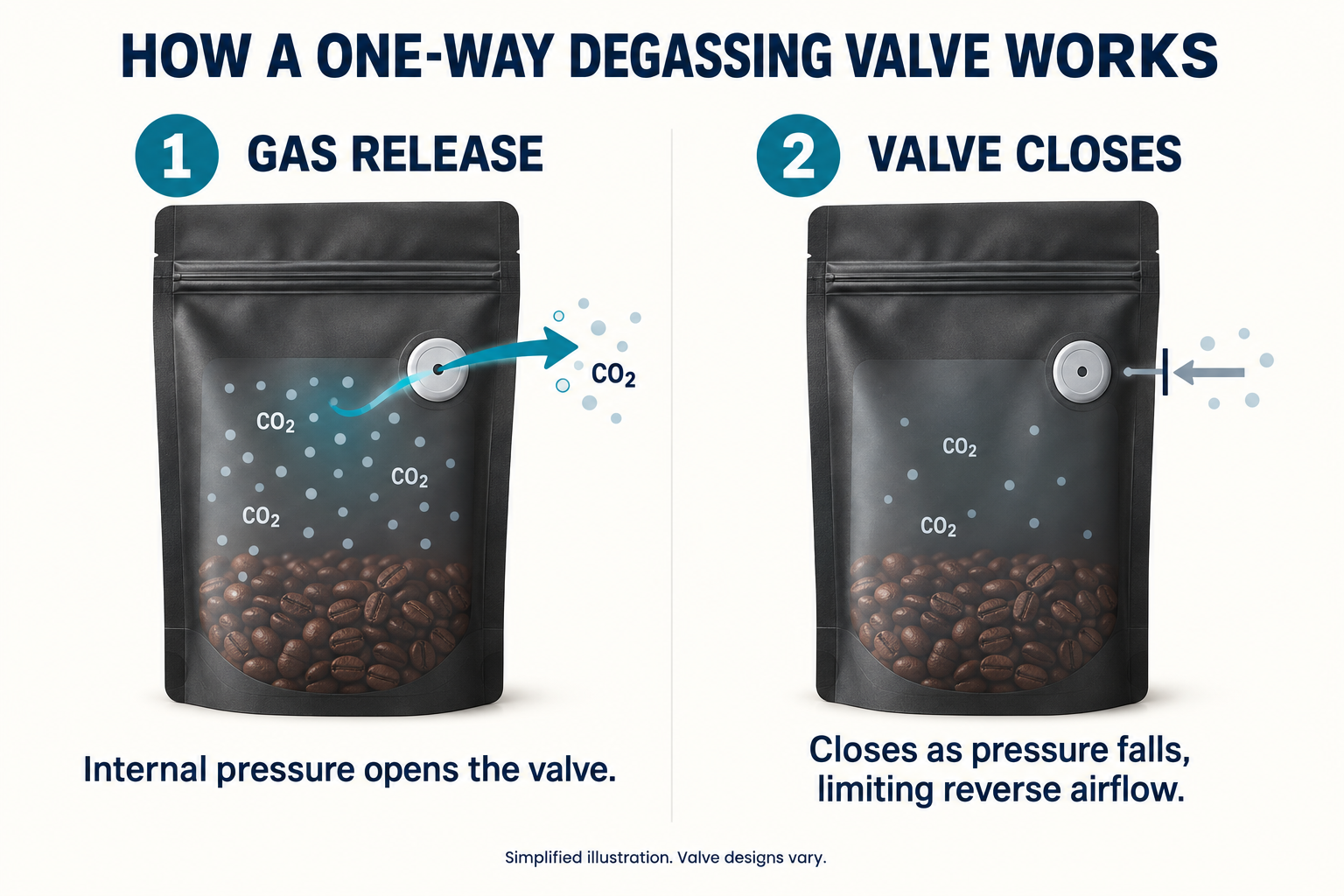
A coffee bag degassing valve manages gas released by the coffee. It does not replace the oxygen and moisture barrier.
Similarly, a zipper provides reclosure after opening. For a bag designed to be heat sealed, it does not replace the initial heat seal or restore the unopened package conditions after use.
If you change the material structure, confirm whether your existing sealing settings remain suitable.
7. Validate Shelf Life with Your Actual Coffee
A material name cannot establish how long your coffee will retain its intended quality.
Shelf-life performance also depends on the coffee itself, roast-to-pack timing, residual oxygen, filling process, seal integrity and storage conditions.
Start by defining the intended shelf life and what acceptable quality means for your product.
Then plan an evaluation using representative coffee, the proposed packaging and the normal packing process.
A practical evaluation may include:
Confirming the sample specification.
Record the construction, dimensions, valve and closure arrangement.Packing under representative conditions.
Use the intended filling and sealing process, including nitrogen flushing if it forms part of normal production.Checking package integrity.
Use suitable methods to assess seals, leaks and handling performance.Storing samples under relevant conditions.
Consider the environments the coffee will encounter during distribution and sale.Reviewing quality at planned intervals.
Use appropriate sensory assessment and other measurements relevant to your product and acceptance criteria.Recording the approved specification.
Keep the material reference, sample details, process settings and evaluation results together.
Visual inspection is useful for finding obvious defects, but it cannot establish barrier performance or shelf life on its own.
Changes to the coffee, material, valve or packing process may require further evaluation.
8. What Should You Send Your Supplier?
You do not need to choose every layer before requesting advice.
A clear application brief helps the supplier propose options that can be compared meaningfully.
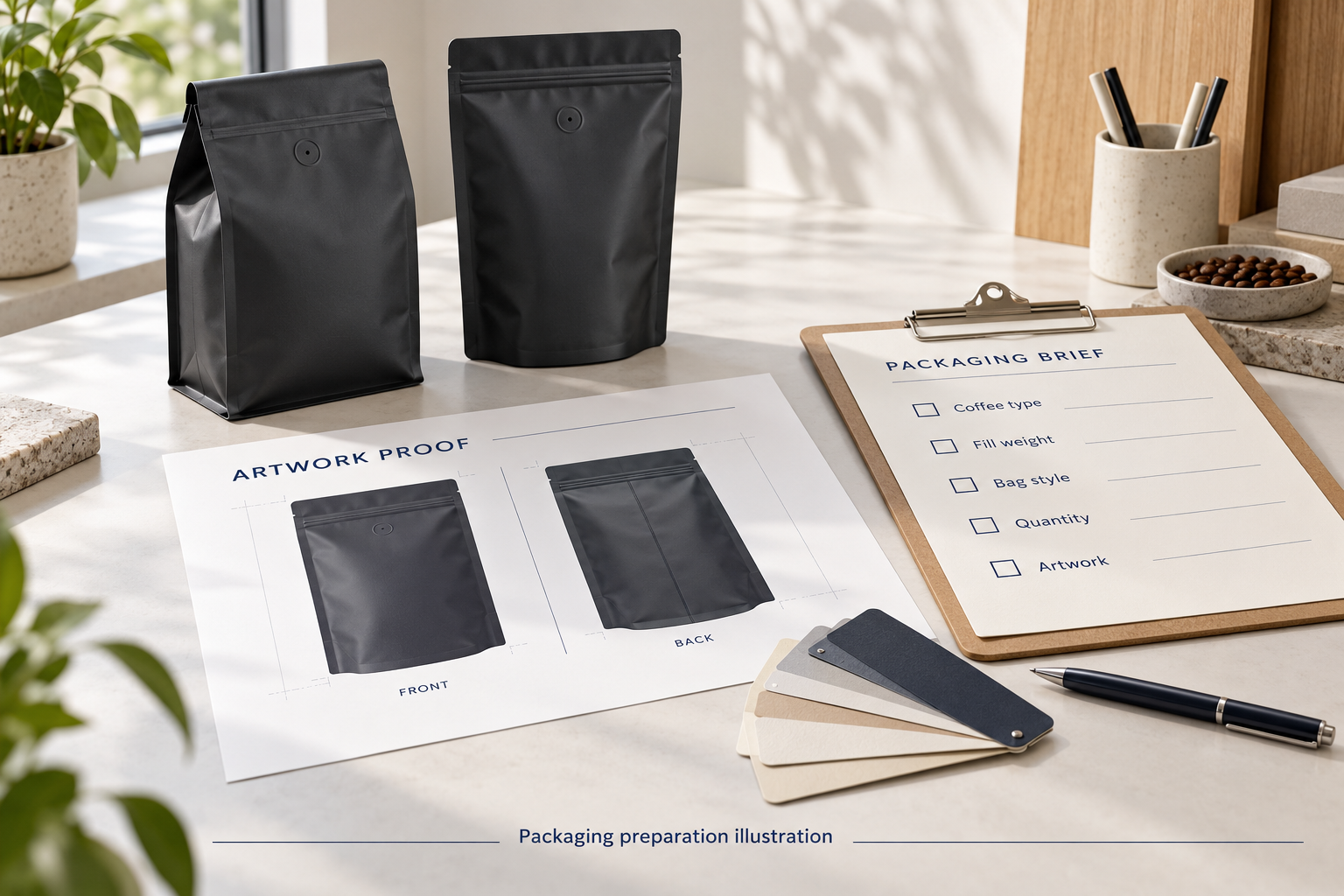
Include:
Whole bean or ground coffee.
Target net weight per bag.
Preferred bag format.
Typical roast-to-pack timing.
Filling and sealing method.
Whether nitrogen flushing is used.
Intended shelf life.
Destination market and expected storage conditions.
Window, finish and appearance requirements.
Valve and zipper requirements.
Any documented recycling or other packaging requirements.
Quantity for each size and design.
If you already use a successful package, provide its specification or a physical sample where practical. Explain what you want to improve, such as sealing consistency, handling strength or material options.
Check dimensions separately using our coffee bag size guide. A material that meets the protection requirements still needs to work with the bag’s capacity, opening and filling process.
When comparing quotations, keep dimensions, features, quantities and performance requirements consistent. Otherwise, a price difference may reflect a different packaging specification.
Frequently Asked Questions
What is the best material for coffee bags?
There is no single best material for every application. Compare complete structures against your coffee, packing process, shelf-life target, distribution conditions and market requirements.
Are foil coffee bags better than metallized coffee bags?
Foil laminates can provide very strong barrier performance, but the purchasing decision also involves package integrity, handling, sealing and cost. Compare relevant data and finished samples rather than selecting from the material name alone.
Can kraft paper coffee bags protect roasted coffee?
They can when the complete construction provides suitable protection. The kraft paper outer layer alone does not establish oxygen barrier, moisture barrier or shelf life.
Are PE-based coffee bags automatically recyclable?
No. Any claim needs to account for the complete package and the collection, sorting and recycling systems relevant to the destination market.
Can I keep the same sealing settings after changing materials?
Do not assume so. A new sealant layer or construction may need different settings. Obtain supplier guidance and validate the process on your equipment.
Can a supplier guarantee freshness from a material specification alone?
A material specification provides part of the evidence. Shelf-life claims also require evaluation of the coffee, finished package, packing process and intended storage conditions.
Discuss Your Coffee Packaging Requirements with FWPacks
Developing a new coffee bag or reviewing your current packaging?
Explore our custom coffee bags, then share your coffee type, target weight, packing process and performance requirements.
If the material is undecided, explain your application and mark the construction as “to be confirmed.”
Contact FWPacks to discuss material options and sample evaluation before approving the final specification.