


Heat sealing closes a coffee bag by bonding its compatible inner sealant surfaces under controlled conditions.
For bags designed with a top heat seal and a resealable zipper, the heat seal provides the initial closure. The zipper allows customers to reclose the package after opening.
To heat seal coffee bags reliably, use equipment suited to the material, keep the sealing area clean and flat, and establish suitable operating conditions through sample trials.
There is no single sealing temperature or machine setting that works for every coffee bag. The material structure, equipment and production process all affect the result.
This guide explains what coffee brands should check before moving from sample bags to regular production.
1. Confirm the Bag Specification Before Choosing Settings
Start with the packaging you will actually use.
Two coffee bags may look similar while using different inner sealant layers, thicknesses or constructions. Those differences can affect how they respond to heat and pressure.
Ask your supplier to confirm:
The inner sealant material.
The recommended sealing area.
Guidance for compatible sealing equipment.
Any available starting conditions for sealing trials.
Whether the proposed bags match the production specification.
Also identify the zipper, tear notches, valve and side seals on the bag drawing.
For a bag intended to be sealed above the zipper, the sealing operation must leave the zipper and opening features functional. Do not choose the seal position only by judging the empty space at the top.
If you are changing materials, treat the new construction as a new sealing trial. Settings used successfully on a previous bag may not transfer directly.
2. Choose Equipment That Matches Your Packing Process
Coffee bags can be sealed using different types of equipment. The appropriate choice depends on the material, bag dimensions, required output and level of process control.
| Equipment type | How it generally works | What to evaluate |
|---|---|---|
| Impulse sealer | Applies heat during a timed sealing cycle | Compatibility with the laminate, sealing length, energy setting and cooling requirements |
| Constant-heat jaw sealer | Maintains heated sealing jaws at a controlled temperature | Temperature control, contact time, pressure and suitability for the material |
| Continuous band sealer | Moves the bag opening through heating and cooling sections | Belt speed, temperature, bag support and consistent positioning |
| Integrated packing equipment | Combines filling and sealing within a larger system | Compatibility across bag handling, filling, gas flushing where used, and sealing |
An impulse sealer may suit some lower-output applications, while a continuous system may be worth evaluating for repeated production.
However, machine category alone does not establish suitability.
Check that the equipment can accommodate the bag’s width, filled weight and construction. For continuous equipment, the bag needs suitable support so its weight does not pull the opening out of position.
Follow the equipment manufacturer’s operating instructions and confirm compatibility using representative packaging samples.
3. Keep the Seal Area Clean, Flat and Accessible
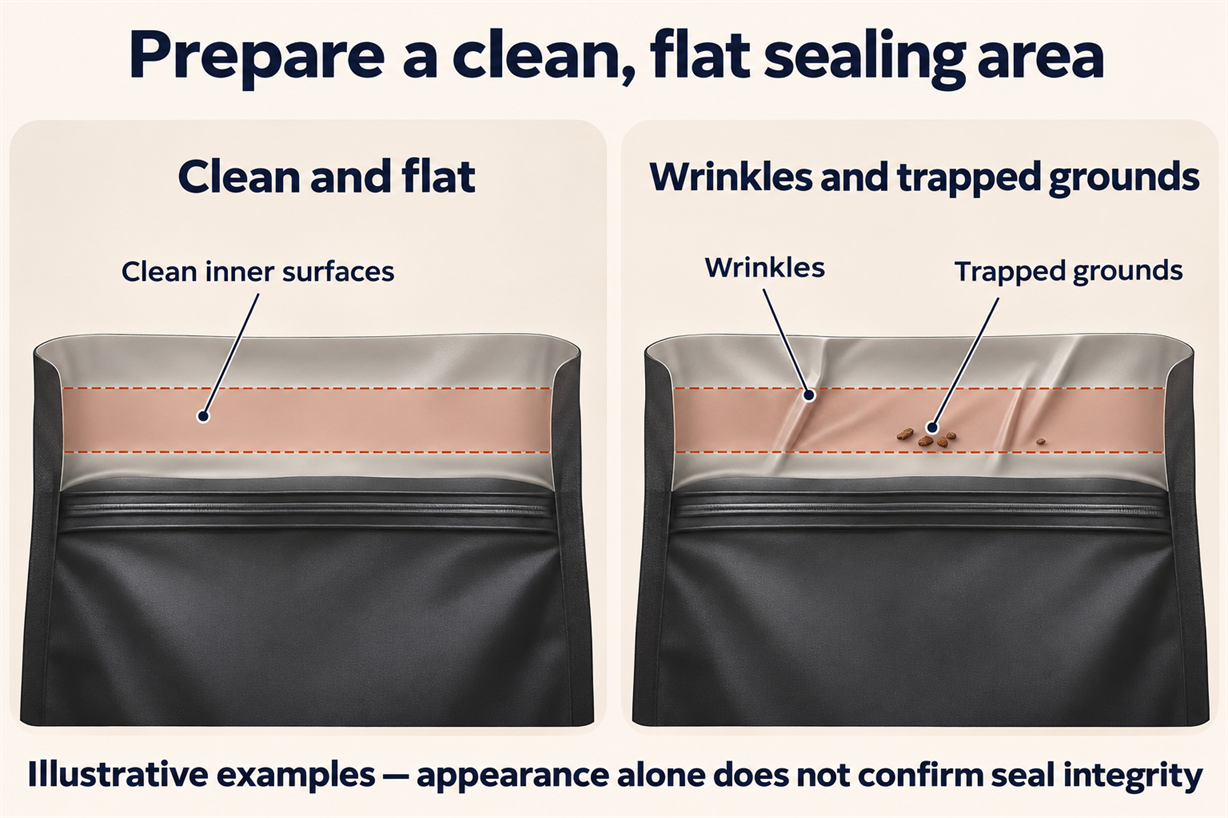
A suitable bag and sealer can still produce poor results if the sealing surfaces are not prepared correctly.
Coffee beans, grounds and other contamination can prevent the inner surfaces from making continuous contact. Wrinkles or folded material can also create channels through the seal.
Before sealing:
Fill to the intended net weight.
Keep coffee below the specified sealing area.
Check that the inside surfaces are free from trapped product.
Flatten the opening without introducing folds.
Position the bag consistently in the equipment.
If contamination happens repeatedly, review the filling process. A wider opening, a better-positioned filling spout or a different bag size may help address the cause.
The package should provide enough usable space for filling and sealing without forcing the product downward or stretching the opening.
Our coffee bag size guide explains why target weight alone does not determine the dimensions you need.
4. Understand Temperature, Time and Pressure
Heat sealing depends on several conditions working together.
Temperature or Heating Energy
The sealant surfaces need enough heat to form a suitable bond.
Insufficient heating can leave a weak or incomplete seal. Excessive heating can distort the material or damage parts of the construction.
Depending on the machine, the adjustable control may be temperature, heating time or an energy setting. These controls are not interchangeable across equipment.
Contact Time
The material must remain under suitable sealing conditions long enough for the bond to form.
On a jaw sealer, this may be controlled through dwell time. On continuous equipment, travel speed affects how long the bag passes through the sealing sections.
Increasing production speed can therefore change the result even when the displayed temperature remains unchanged.
Pressure and Contact
The equipment must bring the sealing surfaces into consistent contact.
Uneven pressure, worn components or poor alignment can cause different results across the width of the bag.
Cooling
The newly formed seal may need to cool while supported before it is exposed to normal handling forces.
Pulling or loading the sealed area too early can interfere with the result.
Ask your supplier and equipment provider for guidance, then establish an operating range through trials. A successful result at one setting does not show how reliably the process will perform under normal production variation.
5. Run a Sealing Trial with Representative Bags
Use samples that represent the material and construction intended for the order.
A trial on a different laminate may help demonstrate the machine, but it does not approve the final packaging.
A practical trial should include the following steps.
Record the starting conditions.
Note the bag specification, machine, settings and filling conditions.
Prepare multiple samples.
One visually acceptable seal is not enough to assess repeatability.
Use the intended packing process.
Evaluate filled bags as well as any empty test samples required by the agreed method. Include gas flushing if it forms part of normal production.
Allow appropriate cooling.
Follow the process requirements before handling or testing the seals.
Inspect and test.
Check appearance and use suitable methods to assess the agreed seal properties.
Adjust systematically.
Change one relevant variable at a time where practical, so the effect can be understood.
Confirm repeatability.
Evaluate results across the intended operating conditions, including normal starts, stops and production speeds.
Keep the trial records with the approved packaging specification. This gives the production team a reference when the bags are reordered or equipment is adjusted.
6. Look Beyond Seal Appearance
A smooth-looking seal is useful, but appearance alone does not establish package integrity.
Different checks answer different questions.
| Check | What it can help assess |
|---|---|
| Visual inspection | Wrinkles, trapped product, incomplete seal areas, distortion and inconsistent positioning |
| Suitable seal-strength testing | The mechanical behavior of the seal under the selected test conditions |
| Appropriate leak testing | Whether unintended leak paths are present within the method’s capabilities |
| Handling and transport evaluation | How the filled package performs during expected distribution |
| Shelf-life evaluation | Whether the complete packaging system protects the coffee over the intended period |
Agree on suitable methods and acceptance criteria with the relevant packaging or quality specialists.
A degassing valve also needs to be considered when selecting a test method. It intentionally allows gas release under certain conditions, so a test that ignores the valve’s function may be misleading.
Read our coffee bag degassing valve guide for more about its role in the packaging system.
7. Troubleshoot Common Coffee Bag Sealing Problems
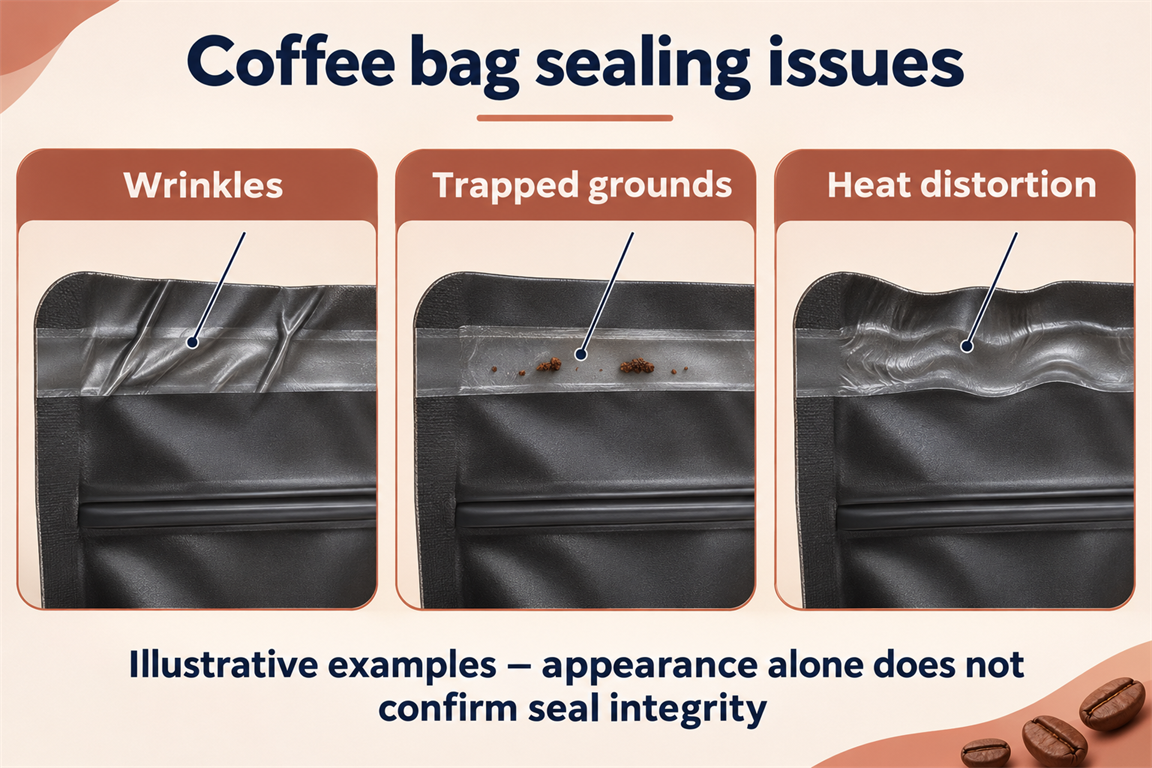
Treat the following as starting points for investigation. The same visible defect can have more than one cause.
| Observed problem | Possible factors to investigate |
|---|---|
| Seal separates easily | Insufficient heat or contact time, poor pressure, contamination or an unsuitable material combination |
| Wrinkles cross the seal | Uneven bag positioning, folds, filling interference or inconsistent bag support |
| Film shrinks, burns or distorts | Excessive heat, excessive contact time or equipment incompatibility |
| One end seals differently from the other | Jaw alignment, uneven pressure, heater condition or worn machine components |
| Results vary during production | Speed changes, warm-up conditions, inconsistent positioning, contamination or equipment condition |
| Seal appears complete but the pack leaks | Small channels, local defects, damage elsewhere in the bag or issues around other components |
Avoid increasing heat automatically whenever a seal fails.
If the actual problem is trapped coffee or poor alignment, additional heat may damage the film without removing the leak path.
Also distinguish gas-related expansion from seal failure. Freshly roasted coffee can continue releasing carbon dioxide after packing. An expanding bag requires investigation of the coffee, valve and packing conditions; its appearance alone does not identify the cause.
8. Keep the Approved Process Consistent
Once a sealing process has been established, record enough information to reproduce and monitor it.
Useful records include:
Bag material and specification reference.
Packaging batch or lot identification.
Equipment identification.
Approved operating settings or range.
Bag positioning and sealing location.
Cooling and handling requirements.
Inspection frequency and test methods.
Acceptance criteria.
Actions to take when results fall outside those criteria.
Check the process after relevant changes, such as a new material construction, equipment maintenance, different production speed or altered filling conditions.
For repeat orders, confirm whether the supplied packaging still matches the approved specification.
Sealing performance is part of the complete packing process. Packaging supply, equipment condition and production control need to work together.
Frequently Asked Questions
What temperature should I use to heat seal coffee bags?
There is no universal temperature. Obtain guidance for the actual material and equipment, then establish suitable conditions through sealing trials. Temperature must be considered together with contact time, pressure and cooling.
Do I need to heat seal a coffee bag that already has a zipper?
For a bag designed with an initial top heat seal, yes. The zipper provides reclosure after opening and does not replace that initial seal.
Can I use the same settings for foil and PE-based bags?
Do not assume so. Different constructions can respond differently to heat and pressure, even when the bags have similar dimensions. Evaluate each proposed specification.
Does a strong seal prove the whole bag is leak-free?
No. Seal strength and leak integrity are different properties. A package can have a mechanically strong seal while still containing a small channel or a defect elsewhere.
Can nitrogen flushing compensate for a poor seal?
No. Nitrogen flushing can reduce oxygen during packing, but a leaking package can allow outside air to enter afterward. The complete process still needs suitable sealing and integrity checks.
Why does my coffee bag expand after sealing?
Continued carbon dioxide release from roasted coffee is one possible cause. Review roast-to-pack timing, valve suitability and operation, storage conditions and package integrity before deciding what to change.
Discuss Your Coffee Bag Sealing Requirements with FWPacks
Preparing a new coffee packaging project or changing your current bag material?
Explore our custom coffee bags, then share your target weight, bag format, filling method and sealing equipment details.
If you are investigating a sealing issue, include the material specification, current settings and clear photographs of the affected area where available.
Contact FWPacks to discuss packaging specifications and samples for evaluation on your equipment.

